Where this unit stands
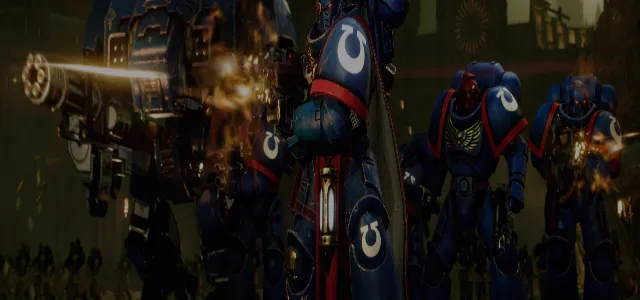
Assault Intercessors matter for a reason beyond themselves: they are how the game showed what a reinforcement is. PC Gamer, playing a preview build at Gamescom and writing on 29 August 2026, describes calling them in during a battle and aiming their drop pods at a mass of Orks, so that the landing itself caused casualties before the squad drew a chainsword. The account adds, elsewhere, that most of the player’s force was still in orbit waiting to be called down. No publisher text names the unit or describes the mechanism.
What the tabletop establishes
On the tabletop, Assault Intercessors are the close-combat half of the same squad type: the same armour and the same price bracket as the standard Intercessor, with a chainsword and a pistol instead of a rifle. The drop pod is older than they are and is one of the setting’s defining images — a cylinder fired from orbit that lands where it is aimed and opens. In the tabletop rules it is a transport that arrives from reserve; the arrival is the point, not the vehicle.
The unit that answers what a reinforcement is in this game. PC Gamer, playing a preview build on 29 August 2026, describes calling in Assault Intercessors and aiming their drop pods at a mass of Orks, so that the landing itself killed before the squad drew a chainsword. On the tabletop, Assault Intercessors are the close-combat counterpart of the standard squad: the same armour, a different problem to solve.
Tabletop identity, as established by Games Workshop. It says nothing about the video game.What has actually been shown
The account is a description of play, not of rules, and the distinction matters here more than usual. What is described: the player chose the moment, chose the place, and the landing killed. What is not described: what it cost, whether there is a limit, how long the squad takes to arrive, whether the enemy can see it coming, and whether the pod itself can be shot down. Every one of those is the difference between a tactical option and a button that wins fights.
What to watch next
The open question is what an aimed arrival does to a Total War battle, because the series has never allowed one. Reinforcements in Total War walk in from a map edge, on a schedule set before the fight, and the whole art of using them is knowing they are coming and where. A squad that lands on a point of the player’s choosing removes the map edge from the equation, and with it the idea that a flank is something you have to reach. The same preview describes using exactly that to answer an enemy in cover — dropping troops behind them or on top of them. If that is cheap, positioning stops mattering; if it is expensive, it becomes the most interesting decision in the battle. Nothing published says which. Information correct as of 4 September 2026.
What is not known
These questions have no published answer as of 29 August 2026. They are listed because an absence of information is information — and because we would rather name the gap than fill it.