Where this mechanic stands
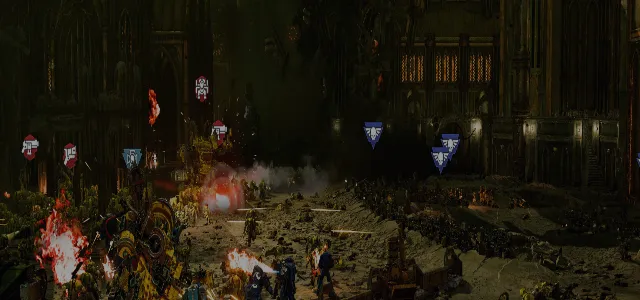
This is the most detailed account of any system in the game, and the site had none of it until 4 September 2026. PC Gamer, writing on 23 July 2026 about an Alpha Strike livestream in which Creative Assembly ran the same battle three times from the player’s side, reports: every projectile simulated, unlimited ammunition, enemy units can be suppressed, line of fire computed for each individual soldier rather than for the unit as a whole, sweeping fire on some units including the Baneblade, and the ability to fire while moving slowly at a cost in accuracy. It adds a Sentry Mode for marking enemies to prioritise before they are in range, and a visual indicator of line of sight when targeting. The build shown was described as two months old.
What the tabletop establishes
Total War has always resolved shooting cheaply, and for a good reason: a battle can contain twenty thousand men, and simulating twenty thousand arrows is not free. So the series abstracts. A unit fires as a body, at a target, and the engine decides how many fall. Ammunition is limited, which is the main thing that keeps missile troops from deciding every battle on their own. None of that survives contact with Warhammer 40,000, where the fiction is that everyone shoots, all the time, and the tabletop rules resolve each model’s weapon separately.
The most detailed system anyone has described, and it comes from the studio’s own broadcast. PC Gamer, reporting on 23 July 2026 on an Alpha Strike livestream in which Creative Assembly ran the same battle three times from the player’s side, lists what it saw: every projectile simulated, unlimited ammunition, suppression of enemy units, line of fire computed per individual soldier rather than per unit, sweeping fire on some units, and the ability to fire while moving slowly at a cost in accuracy. On the tabletop, shooting is the phase that decides most games — and Total War has never modelled it at this resolution.
Tabletop identity, as established by Games Workshop. It says nothing about the video game.What has actually been shown
Two of the reported details are unusual enough to isolate. Unlimited ammunition removes the constraint the series has always used to stop ranged troops dominating — which means something else has to do that job, and the account suggests it is cover, suppression and positioning rather than a counter that runs out. And line of fire computed per soldier means the men in one unit can be shooting at different enemies at the same time, depending on what each of them can see. That is not a refinement of the existing system; it is a different system that happens to produce a similar picture.
What to watch next
The open question is what stops a firing line from winning every battle. Take the reported details together — everyone shoots, nobody runs out, projectiles are real objects, and each soldier picks his own target — and the natural result is that whoever sets up first and has the better angles wins before contact. The same coverage names three things that presumably prevent it: cover, which raises defence and lowers the chance of being hit; suppression, which does something unspecified to a unit under fire; and terrain that changes shape as the battle goes on, so a good position stops being good. Whether those three are enough is the whole balance of the game, and no number attached to any of them has ever been published. Information correct as of 4 September 2026.
What is not known
These questions have no published answer as of 23 July 2026. They are listed because an absence of information is information — and because we would rather name the gap than fill it.