Where this mechanic stands
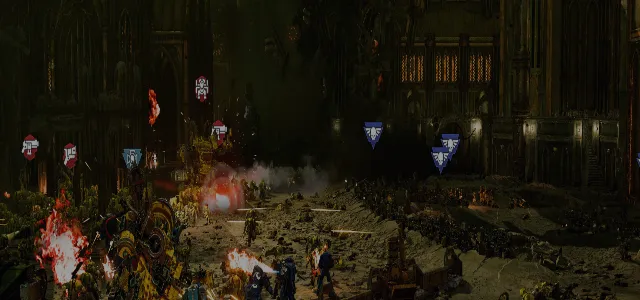
PC Gamer, reporting on 9 June 2026 on the gameplay shown at the PC Gaming Show, writes that Creative Assembly has crafted a planet creation system that will flesh out the universe, alongside maps of gigantic scale with plenty of variation and destructible scenery. Four words — a planet creation system — are the whole of the published record. No publisher text mentions it, no other outlet repeats it, and nobody has said whether a player ever touches it. This page exists because a system with that name would be the largest structural fact about the game, and because one preview sentence is a thin place to leave it.
What the tabletop establishes
Total War has never generated its own ground. Every battle map in the series is authored: a designer builds it, places the hill and the wood and the ford, and the campaign map decides which of those authored maps a given fight uses. That is why the series has hundreds of maps rather than infinite ones, and why veterans learn them. The tabletop is the same principle by other means — scenery is placed by hand before the first turn, from what the players own. Neither tradition contains anything that makes a world.
PC Gamer, reporting on 9 June 2026 on the gameplay reveal shown at the PC Gaming Show, writes that Creative Assembly has crafted a planet creation system that will flesh out the universe, alongside maps of gigantic scale with plenty of variation. Four words — a planet creation system — and no other source names it. On the tabletop there is no equivalent: a battlefield is assembled by hand from scenery a player owns, and no rule generates a world.
Tabletop identity, as established by Games Workshop. It says nothing about the video game.What has actually been shown
The phrase is doing an enormous amount of work for four words, and it is worth separating what it could mean. It might describe a tool the studio used internally to author many planets quickly, in which case the player sees variety and nothing else. It might describe generation at runtime, in which case no two campaigns share a galaxy. Or it might be a player-facing feature — choose a world type, get a world — which would be a first for the series in a different way again. The account attaches it to fleshing out the universe, which fits the first reading best, and that is an inference from a preposition.
What to watch next
The open question is whether the galaxy is authored or generated, and it decides what kind of game this is over years rather than hours. An authored galaxy can be learned, and learning it is most of what a Total War veteran does — the fixed map is what makes a campaign a puzzle with a known shape. A generated one cannot be learned, only read, which is a different skill and a different genre pull. It also bears directly on the reported intention to keep adding to one sandbox rather than shipping sequels: a system that makes worlds is exactly what a game would need to keep growing without hand-building every addition. Those two reports have never been connected by anyone, including their own outlet. Information correct as of 4 September 2026.
What is not known
These questions have no published answer as of 9 June 2026. They are listed because an absence of information is information — and because we would rather name the gap than fill it.