Where this mechanic stands
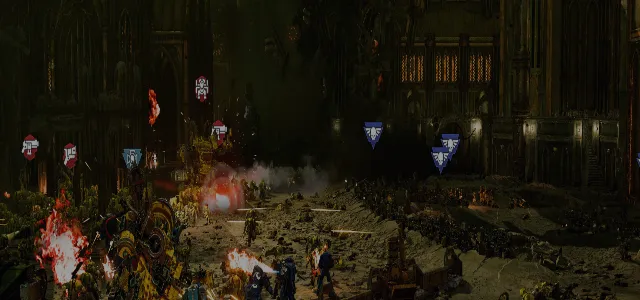
The publisher’s description of the game, read on its official store listing on 4 September 2026, states that the player strategically deploys powerful abilities to dominate the flow of battle, and names three: haphazard artillery bombardments, aerial strafing runs, and laser-powered strikes. The same paragraph adds that every impact reshapes the terrain, creating new cover and fresh tactical opportunities. Three named abilities and one consequence is the whole of it. No cost, no cooldown, no source and no targeting rule has been described by anyone.
What the tabletop establishes
The Warhammer trilogy solved this problem with magic. A shared pool of winds accumulates during a battle, wizard characters spend it on spells, and the spells are the reason a player watches the battle rather than autoresolving it. Warhammer 40,000 has no equivalent: psychic power exists but belongs to a small number of specialists, and everything else that falls out of the sky is ordnance. So a game in this setting that wants the same rhythm — a resource, a decision, a moment — has to build it out of artillery and aircraft instead of sorcery. That is a different problem, and this sentence is the only evidence anyone has that the studio is solving it.
The publisher’s description of the game names three abilities a player deploys during a battle: haphazard artillery bombardments, aerial strafing runs, and laser-powered strikes. It adds that every impact reshapes the terrain, creating new cover. On the tabletop, effects of this kind are bought before the game as off-board assets and resolved on a die roll — they are deliberately unreliable, and the unreliability is the price of the power.
Tabletop identity, as established by Games Workshop. It says nothing about the video game.What has actually been shown
Press coverage has since put flesh on this. The studio broadcast of 23 July 2026, as reported by PC Gamer, describes airstrikes and army-wide abilities, and says that for the Astra Militarum these are Regimental Orders which only affect troops close to command units and vox-casters — as on the tabletop. That is the first cost anyone has described for any ability in this game, and it is not a resource: it is a position. One word in the publisher’s own sentence is also doing more work than the rest, and it is haphazard. Marketing copy does not usually advertise that a feature is unreliable. On the tabletop, an off-board bombardment scatters: the player nominates a point and a die decides how far from it the shells actually land, and that unreliability is the price of being able to hit anything on the table. An artillery bombardment described as haphazard in the publisher’s own words reads like that mechanic named rather than a stylistic flourish — but it is one adjective, and reading a system out of an adjective is exactly what this site refuses to do.
What to watch next
The open question is where these abilities come from, and it changes what kind of battle this is. If they belong to a character on the field, they are the trilogy’s spells with the serial numbers filed off, and a player builds an army around who can call them. If they belong to the campaign layer — an orbiting fleet, a stockpile of shells, an air wing based on another continent — then a battle is no longer decided only by what stands on the field, and the campaign reaches into the fight in a way no Total War has allowed. The publisher’s sentence mentions fleets nowhere and characters nowhere; it attaches the abilities to the player and nothing else. The reported Regimental Orders point somewhere else again — to units on the field whose job is to carry the order rather than to fight — which is a third answer the publisher’s wording does not contain. Whether that arrangement is particular to the Astra Militarum or the shape of the system for everyone has not been stated. Information correct as of 4 September 2026.
What is not known
These questions have no published answer as of 23 July 2026. They are listed because an absence of information is information — and because we would rather name the gap than fill it.