Where this mechanic stands
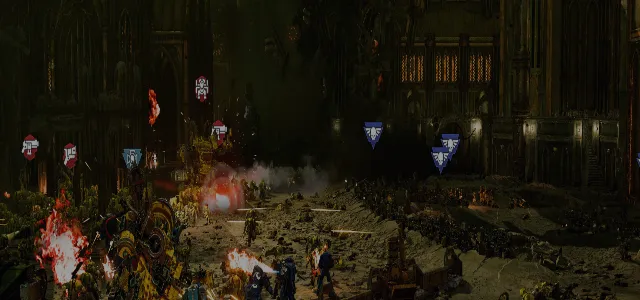
Playing the Ultramarines on a preview build at Gamescom, PC Gamer reports on 2 September 2026 that its settlement garrison was made of ordinary soldiers of the Planetary Defence Force — units that defended the settlement in the way a Total War garrison does, but that a Space Marine faction cannot recruit. In two separate battles, an Astra Militarum army was already fighting the Orks when the player arrived, present as an allied force the player could not control. Battle products owner Dave Petry is quoted saying the studio has been playing around with concepts like gaining support to be able to bring along units with you to fight your battles. The publisher has published nothing on any of this.
What the tabletop establishes
The Imperium of Man is not an alliance, it is an administration, and that is the whole difficulty. A Space Marine Chapter is a thousand warriors with their own fleet, their own fortress and no territory to speak of; the Astra Militarum is measured in billions and holds the ground. The Planetary Defence Force is the layer below both — every Imperial world is required to raise and pay for its own troops, who are not good, are not going anywhere, and are the first thing any invader meets. In the fiction, a Chapter that arrives on a world does not command its defenders. It asks.
Playing the Ultramarines at Gamescom, PC Gamer reports that its settlement garrison was made of ordinary soldiers of the Planetary Defence Force — units that defended the settlement but that a Space Marine faction cannot recruit. In two battles, an Astra Militarum army was already fighting when the player arrived, present as an allied force the player could not control. Battle products owner Dave Petry is quoted saying the studio has been playing around with concepts like gaining support to be able to bring along units with you to fight your battles.
Tabletop identity, as established by Games Workshop. It says nothing about the video game.What has actually been shown
Two of the three reported details are things the player could not do, and that is what makes them interesting. The garrison existed and could not be recruited. The allied army existed and could not be controlled. The third detail is a quote about a concept, and Petry’s own framing is careful — the studio has been playing around with it, which is not a description of a feature. Read together they describe a faction that is powerful and small, operating inside somebody else’s structure, which is the correct reading of what a Space Marine Chapter is. Whether any of it is a system rather than a demo arrangement has not been stated.
What to watch next
The open question is whether an uncontrollable ally is a design or a limitation. Total War has fielded allied armies for years and they are consistently the least satisfying part of a battle: they show up, they do something unhelpful, and the player watches. A game whose central faction is explicitly not in charge of the ground it fights on has to make that feel like a position rather than an annoyance — and the only lever anyone has described for it is support that must be gained, which points at a currency of standing rather than command. If that works, being unable to order the Astra Militarum around becomes the interesting part of playing Space Marines. If it does not, it becomes the part players ask to have removed. Nothing published indicates which way it has gone, and the studio describes it as still moving. Information correct as of 4 September 2026.
What is not known
These questions have no published answer as of 2 September 2026. They are listed because an absence of information is information — and because we would rather name the gap than fill it.